I have an unusual vantage point on this.
During the week I manage HR systems for a large organization. I know what the data looks like. I know where the processes are broken. I know how resistant most HR functions are to changing anything that isn’t actively on fire.
On weekends I build with AI. I know what these tools can actually do, where they fail, and how fast they’re improving.
Those two worlds are colliding. Faster than most HR departments realize.
What AI Can Do in HR Right Now
Let me be concrete, because the abstract version of this conversation is useless.
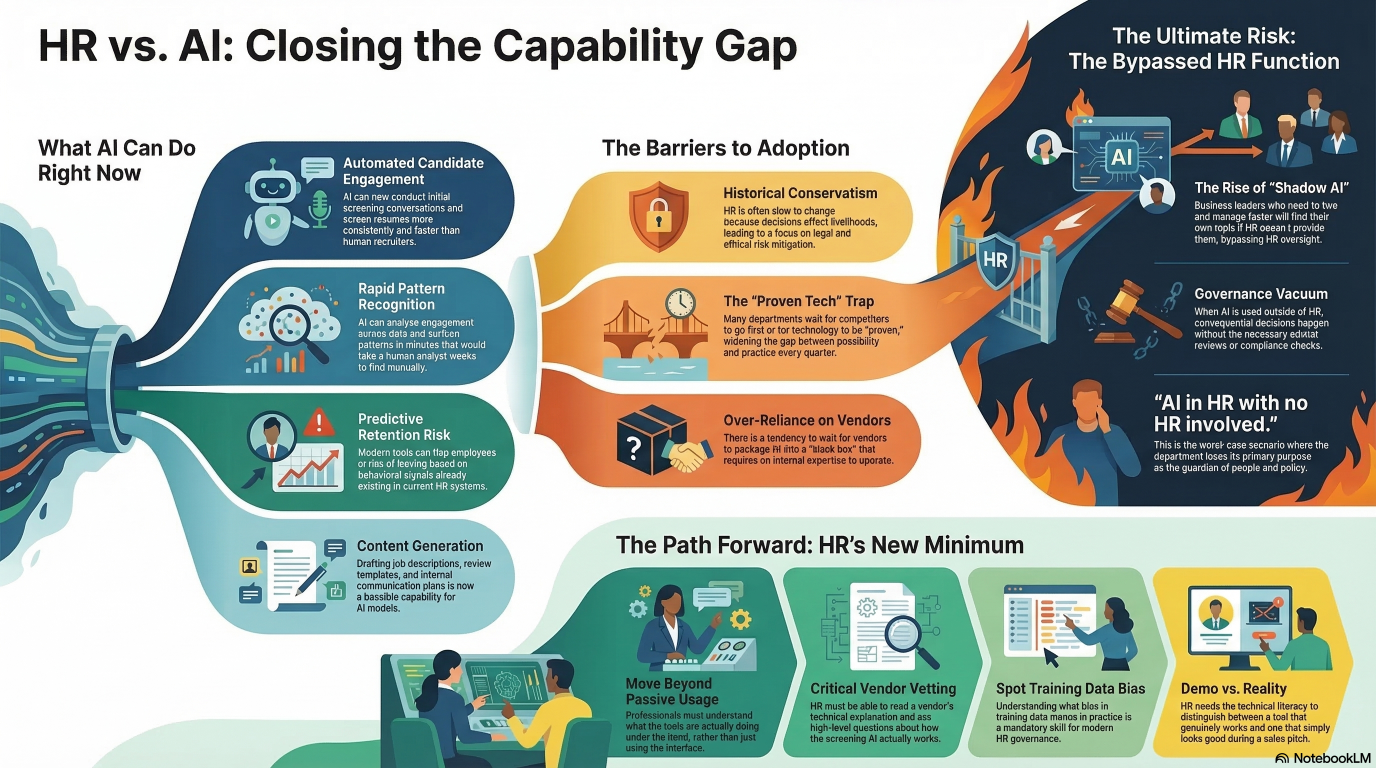
AI can screen resumes faster and more consistently than humans. It can conduct initial screening conversations with candidates. It can analyze engagement survey data and surface patterns that would take an analyst weeks to find manually. It can draft job descriptions, review templates, communication plans. It can flag retention risk based on behavioral signals already sitting in your existing systems.
None of this requires frontier models. None of this is experimental.
This is available. Affordable. Today.
Why HR Is Behind
A few reasons. I say this with some affection for the function.
HR is historically conservative about technology. There are legitimate reasons — these decisions affect people’s livelihoods and there are real legal and ethical risks. Caution makes sense.
But there’s a difference between thoughtful caution and just being slow.
A lot of what I see is the second thing. Waiting for the technology to be “proven.” Waiting for a competitor to go first. Waiting for a vendor to package it in a way that requires no internal expertise and no real understanding of how it works.
Meanwhile the technology is moving. The gap between what’s possible and what HR is actually doing is getting wider every quarter.
The Risk Nobody Is Talking About
Here’s what worries me most: HR functions that don’t adapt don’t disappear.
They get bypassed.
Business leaders who need to hire faster, understand their workforce better, manage performance more effectively — they don’t wait for HR to catch up. They find tools that work and use them outside of HR’s oversight.
You end up with AI making consequential HR decisions without the governance, without the ethical review, without the compliance checks that HR is supposed to provide.
That’s worse than HR adopting AI imperfectly.
That’s AI in HR with no HR involved.
What Needs to Happen
HR professionals need to get uncomfortable with this technology. Not as passive users of whatever vendors sell them — as people who understand what the tools are actually doing.
You don’t need to train a model. But you should be able to read a vendor’s explanation of how their screening AI works and know what questions to ask. You should understand what bias in training data means in practice. You should be able to tell the difference between a tool that genuinely works and one that looks good in a demo.
That’s the minimum.
And right now, most HR functions aren’t there.
The technology isn’t waiting.
And neither is the business.