The data center is dead.
Not the building. The concept.
What Jensen Huang (NVIDIA CEO) announced at GTC 2026 wasn’t a product launch. It was a reframe of the entire industrial model. The data center — that thing companies built to store and retrieve — is now a factory. Raw material in. Intelligence out. The unit of output: the token.
What Actually Changed
Old data centers were warehouses. You put data in. You got data back. Storage, retrieval, compute on demand. Passive infrastructure. Cost center. IT problem.
AI factories are different at a structural level.
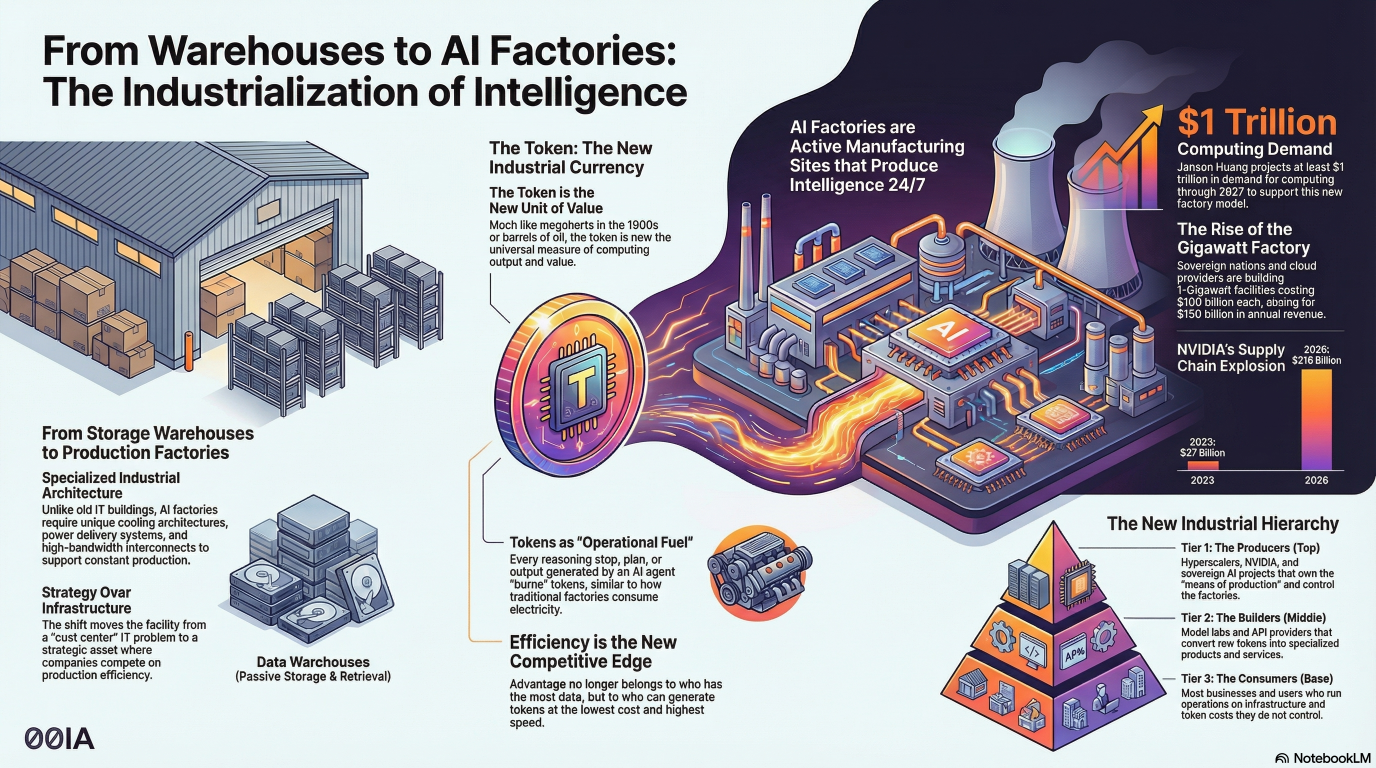
Traditional data centers were built to store and retrieve data. AI factories are designed to produce intelligence — in the form of tokens. They run 24/7. They have cooling architectures, power delivery systems, and high-bandwidth interconnects that look nothing like what came before.
This isn’t an upgrade. It’s a different category of facility.
The Token Is the Unit
In the 1990s, Intel made MHz the universal measure of computing value. The whole industry organized around that metric. Jensen is doing the same with tokens.
Once a unit becomes the standard — MHz, barrels, kilowatt-hours — the company that controls its production wins by default.
Jensen Huang said it plainly: “In the age of AI, intelligence tokens are the new currency, and AI factories are the infrastructure that generates them.”
That’s not a metaphor. That’s a production model.
Every time an AI agent reasons through a decision, plans a sequence, drafts an output — it’s consuming tokens. Every enterprise running agents at scale is buying tokens the way factories once bought electricity.
The question is who produces them.
The Scale Is Not Abstract
Major cloud providers and sovereign nations are already building what Huang calls “1-Gigawatt AI Factories” — facilities projected to cost upwards of $100 billion each, expected to generate $150 billion in annual revenue by selling tiered token packages.
Nvidia went from $27 billion in annual revenue in 2023 to $216 billion in 2026. Three years. That is not a growth curve. That is a supply chain being built in real time.
Huang quantified the demand: “$1 trillion in computing demand through 2027 — at least.”
At least.
Why This Matters Beyond the Hardware Story
Here’s what most coverage misses.
The shift from data center to AI factory isn’t just an infrastructure story. It’s a strategic restructuring of where value gets created.
In the warehouse era, companies competed on data access. Who had the most, who could query it fastest.
In the factory era, companies compete on token production efficiency. The companies that win won’t just be the ones with the most data — they’ll be the ones who can generate tokens at the lowest cost and the highest speed to power a workforce of digital and physical agents.
Cost per token is the new cost per unit. And the gap between producers and consumers of tokens will define competitive advantage the way oil refineries once did.
What This Looks Like From the Inside
I work in HRIS. I build AI systems on weekends. I’m not building gigawatt factories. I’m a consumer of this infrastructure.
But I feel the shift already.
Every AI soluation deployed is drawing from a token budget. Every automation designed has a cost per reasoning step. The question I’m asking when I architect a system has changed — not just “does this work?” but “how many tokens does this burn, and is the output worth it?”
That’s the factory mindset applied at the operator level. You don’t need to own the factory to think like a manufacturer.
Your HRIS Is Now Plugged Into the Factory
HR platforms are not waiting for permission.
Workday, SAP SuccessFactors, Oracle HCM — every major HRIS vendor is embedding AI features directly into the core product. Skills inference. Attrition prediction. Candidate scoring. Copilots for managers. Automated job description generation. Performance summarization.
None of it runs on air.
Every one of those features is a token consumer. Every time a manager asks the system to summarize a review cycle, every time the platform generates a development plan, every time an AI assistant responds to an HR ticket — the factory is running in the background.
Tokens are the new electricity.
And just like electricity, most users don’t think about where it comes from. They flip the switch. The lights come on. The bill arrives somewhere else.
The difference is that electricity costs were predictable and stable. Token costs are still volatile, still being priced, still being understood at the enterprise level.
The features are real. The value is real. But the dependency being created underneath — on token production infrastructure owned by a handful of companies — is also real.
Every “AI-powered” checkbox in your next HRIS RFP is a line item in someone’s factory output.
The New Industrial Hierarchy
The hierarchy is forming fast.
At the top: the companies building and owning the factories. NVIDIA, the hyperscalers, the sovereign AI projects. They control the means of token production.
In the middle: the companies building on factory output. The model labs, the inference providers, the API economy. They’re converting raw tokens into products.
At the base: everyone else. Buying tokens. Consuming intelligence. Running their businesses on infrastructure they don’t control.
There’s nothing wrong with being at the base. Most businesses will live there. But knowing which tier you’re in — and being deliberate about it — is the difference between strategy and drift.
The industrial revolution didn’t ask permission. It restructured who had leverage and who didn’t before most people understood what was happening.
The token factory era is doing the same thing. Faster.
The factory is already running. The question is what you’re building with what it produces.